
Katori Pure Titanium Cutting Board Review
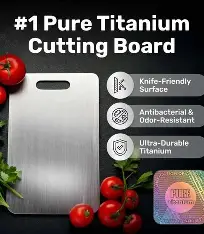
Cutting boards are one of those kitchen tools most of us don’t think about until they start looking terrible.
A new plastic board looks perfectly clean.
Then the knife marks appear.
A few months later, the surface is covered in scratches, stains are harder to remove, and strong foods can leave behind unwanted smells.
Wood looks much better, but it comes with its own maintenance routine.
That’s what makes the Katori Pure Titanium Cutting Board interesting.
It’s marketed as a premium titanium food-preparation surface that doesn’t absorb liquids like porous materials, doesn’t require oiling, and won’t wear like a conventional plastic board.
But with a price far above a basic cutting board, it needs to offer more than a premium-looking piece of metal.
Katori Quick Look
Editor’s Rating: ★★★★☆ 4.4/5
Product: Katori Pure Titanium Cutting Board
Category: Premium Kitchen Cutting Board
Material: Titanium claimed
Surface: Matte/brushed metal
Thickness: Around 2mm listed
Cleaning: Dishwasher-safe claimed
Best For: Frequent home cooks wanting a non-plastic, low-maintenance prep surface
Price Range: Approximately $89–$179 in the supplied reference
The problem isn’t your plastic board when it’s new
It’s what happens after you’ve used it hundreds of times.
Every time you chop an onion, slice chicken, mince herbs, or cut vegetables, your knife leaves tiny marks on the surface.
Eventually those marks become obvious grooves.
At that point, even a freshly washed plastic board can look worn.
That’s one reason the idea behind Katori makes sense.
Instead of using a softer plastic cutting surface that gradually becomes heavily scored, Katori is marketed around a durable, non-porous titanium surface.
What is the Katori Titanium Cutting Board?
Katori is essentially a metal alternative to the wooden, bamboo, and plastic boards found in most kitchens.
The supplied information describes it as having a matte brushed finish, rounded edges, and a thickness of approximately 2mm.
The big selling point is titanium.
Titanium is known for corrosion resistance and a high strength-to-weight ratio, which makes it an interesting material for a reusable kitchen surface.
Katori’s reference material goes further and describes the board as pure, food-grade titanium.
However, the same source later acknowledges that Katori’s purity claims aren’t currently supported there by publicly posted test results.
So I’d verify the exact material specification before paying a premium specifically for “pure titanium.”
Why a non-porous surface matters
This is Katori’s most appealing feature.
A non-porous surface doesn’t absorb food juices into the material itself.
Cut garlic and onions?
Clean the surface.
Prepare fish?
Clean it again.
Cut acidic fruit?
Wash it when you’re finished.
There’s no grain that needs oiling and no plastic surface involved in the cutting area if the board’s titanium construction is as described.
That can make everyday maintenance extremely straightforward.
But non-porous doesn’t mean bacteria can’t touch it
This distinction is important.
Some marketing around metal cutting boards makes it sound as though bacteria simply can’t exist on them.
That’s too broad.
Raw meat can contaminate a titanium surface just as it can contaminate another food-contact surface.
The difference is that a non-porous material doesn’t absorb those juices into the board itself.
You still need to wash it correctly.
You still need to avoid cross-contamination.
And you still need to sanitize food-contact surfaces when appropriate.
So Katori’s advantage is better described as easy-to-clean and non-absorbent, rather than automatically bacteria-free.
Cleaning is where Katori gets really convenient
Wood can be beautiful, but you have to treat it properly.
Don’t leave it soaking.
Dry it correctly.
Depending on the board, oil it periodically.
Katori eliminates much of that routine.
For ordinary preparation, wash it with appropriate dish soap and water.
The supplied information also describes it as dishwasher-safe.
That’s particularly attractive after preparing foods such as raw meat or fish, where thorough cleaning matters.
And food odors shouldn’t soak into the board
Ever cut garlic on a board and smell it later?
A non-porous metal surface doesn’t absorb food compounds in the same way porous materials can.
That’s useful if you use one board for lots of different foods.
Fish today.
Fruit tomorrow.
Garlic tonight.
Clean the surface properly between uses and you don’t have an absorbent cutting material holding onto those liquids.
The knife question can’t be ignored
Here’s where Katori becomes more complicated.
Titanium is still a metal.
The supplied marketing says the board is knife-friendly and argues that it performs well for edge retention.
I wouldn’t turn that into a blanket promise that a titanium board won’t affect knife sharpness.
Your knife edge physically contacts the cutting surface thousands of times.
Material hardness matters.
A quality wooden cutting board remains an attractive choice for people who own expensive knives and prioritize edge preservation.
Katori offers a different tradeoff:
less maintenance and a non-porous surface, but a harder cutting experience than wood.
Whether that’s better depends on your priorities.
What does chopping on metal feel like?
Different.
If you’ve used wood for years, don’t expect Katori to feel the same.
The board will have a firmer response underneath the knife.
You’ll probably hear more metallic sound during fast chopping.
And the cutting sensation may take a little getting used to.
The supplied customer-feedback section specifically mentions metallic sound as something some buyers notice.
That’s not necessarily a problem.
It’s simply part of switching materials.
Yes, it will scratch
Don’t buy a titanium cutting board expecting it to remain cosmetically perfect.
Knives leave marks.
The reference itself reports light surface scratching after extended use.
That’s normal.
The more important question is whether those cosmetic marks affect the board’s practical usefulness.
A few scratches on a metal prep surface are very different from expecting a kitchen tool to look untouched forever.
The sliding issue is more important
One feature I’d like to see improved is the base.
A thin metal board on a polished countertop can move while you’re chopping.
The supplied customer feedback mentions this issue, particularly on smooth surfaces such as marble, quartz, and polished granite.
The solution is inexpensive:
Put a non-slip silicone mat underneath it.
I’d do that from day one.
A cutting board moving under a sharp knife isn’t something worth taking chances with.
Editor’s Verdict
★★★★☆ 4.4/5
Katori is appealing because it solves several annoyances associated with conventional cutting boards.
No plastic cutting surface.
No wood oiling.
No worrying about the board swelling after getting wet.
No absorbent surface holding onto food juices.
And no need to replace it simply because the surface looks heavily worn after a year or two.
The tradeoffs are equally clear.
It’s expensive.
It’s harder than wood.
It can make more noise.
And I’d like stronger public documentation supporting the exact material-purity claims.
For frequent home cooks who prioritize low maintenance, durability, and moving away from plastic, however, Katori is one of the more interesting cutting-board concepts.
What We Liked
- Non-porous surface
- No plastic cutting surface if construction is as claimed
- Corrosion-resistant material
- Easy everyday cleaning
- Dishwasher-safe according to supplied information
- No wood oiling required
- Doesn’t absorb liquids like porous materials
- Resistant to warping
- Resistant to cracking
- Useful with acidic ingredients
- Thin design
- Rounded edges listed
- Long-term-use potential
What Could Be Better
- Premium purchase price
- Harder than wooden cutting surfaces
- Knife wear needs consideration
- Surface scratching is inevitable
- Metallic chopping sound
- May slide on polished counters
- Non-slip base isn’t standard according to the supplied comparison
- Exact titanium purity deserves stronger verification
Katori vs. Plastic: Which Would I Choose?
For the lowest price?
Plastic.
For a board you can replace cheaply whenever it becomes heavily worn?
Again, plastic.
But if your goal is to stop buying plastic cutting boards altogether, Katori becomes more interesting.
Plastic inevitably becomes scored through knife use.
Katori will develop cosmetic scratches too, but it isn’t a conventional plastic surface being repeatedly cut during food preparation.
For someone specifically trying to reduce plastic use in the kitchen, that’s a meaningful difference.
Katori vs. Wood: A Much Harder Decision
This one depends entirely on what you value.
Choose Katori if you want:
Minimal maintenance.
A non-porous surface.
Easy cleaning.
No oiling.
Strong corrosion resistance.
Choose Wood if you want:
A traditional cutting feel.
A warmer kitchen appearance.
A more forgiving surface for fine knife edges.
A board that can potentially be resurfaced.
Personally, I wouldn’t call either material universally superior.
They’re optimized for different priorities.
Can you prepare raw meat on Katori?
The product is marketed for meat, seafood, vegetables, fruits, and general kitchen preparation.
But using titanium doesn’t change basic food-safety rules.
After preparing raw meat or poultry, properly wash and sanitize the board before placing cooked or ready-to-eat food on it.
The non-porous surface makes cleaning straightforward.
It doesn’t eliminate the need for cleaning.
What about acidic foods?
Titanium is valued for its corrosion resistance, which makes the material concept attractive for foods such as tomatoes, citrus, and other acidic ingredients.
The supplied reference specifically markets Katori for acidic foods.
For product-specific food-contact claims, however, I’d still want the manufacturer’s material documentation.
Is Katori really a lifetime cutting board?
I’d avoid making that promise.
Titanium itself is highly durable.
That doesn’t automatically prove that every component of a finished Katori board will last forever.
The source promotes a lifetime-style durability message, but long-term product-specific evidence and detailed warranty conditions would be needed before treating that as guaranteed.
A safer conclusion is:
Katori should have the potential for a very long usable life if its construction matches the supplied specifications and it’s cared for properly.
Katori Price
The supplied reference puts the general retail range at approximately:
$89–$179
The final amount depends on the size, promotion, and purchasing channel.
That’s significantly more than a basic plastic cutting board.
But Katori isn’t really competing with a $10 board on upfront price.
The argument is that you spend more now for a durable preparation surface that you may use for considerably longer.
Whether that math works for you depends on how frequently you cook and what kind of boards you’re currently replacing.
Check Katori Price & Availability
Verify today’s size options, material specifications, package contents, return policy, and warranty before ordering.
Who is Katori Best For?
I’d consider Katori if you:
- Cook almost every day
- Want to stop using plastic cutting boards
- Want a non-porous food-preparation surface
- Regularly prepare meat or fish
- Frequently chop onions and garlic
- Want easier cleaning
- Don’t want to oil a wooden board
- Want something corrosion resistant
- Prefer durability over low initial price
- Don’t mind a firmer cutting surface
Who Should Skip It?
Katori probably isn’t your best choice if:
- You only cook occasionally
- You’re shopping on a tight budget
- You love traditional wooden boards
- You own expensive knives and prioritize edge preservation
- You dislike metallic chopping sounds
- You expect a cutting board to remain scratch-free
- You don’t want to use a non-slip mat
Frequently Asked Questions
What is the Katori Pure Titanium Cutting Board?
It’s a premium kitchen prep board marketed as using a titanium cutting surface instead of plastic, wood, bamboo, or glass.
Is Katori actually pure titanium?
The reference describes it as pure titanium but also acknowledges that publicly posted testing supporting Katori’s exact purity claim isn’t currently provided there.
Material-conscious buyers should verify the manufacturer’s current documentation.
Does Katori contain plastic?
The supplied reference describes the cutting board as pure titanium. I’d verify the construction of the exact model being purchased, particularly if avoiding plastic is your main reason for buying it.
Is titanium non-porous?
Titanium itself is a non-porous metal.
Is Katori antibacterial?
I wouldn’t describe it as automatically antibacterial or bacteria-proof without appropriate product-specific testing.
Its practical advantage is that a non-porous surface doesn’t absorb food juices into the material and can be cleaned.
Can bacteria still get on Katori?
Yes.
A dirty titanium surface can still become contaminated.
Wash and sanitize it appropriately.
Can I cut raw chicken on it?
It’s marketed for raw meat preparation.
Clean and sanitize the surface thoroughly afterward and avoid cross-contamination with ready-to-eat foods.
Does Katori hold food odors?
A non-porous titanium surface shouldn’t absorb odors the way porous materials can. Any food residue left on the surface still needs to be cleaned away.
Will it dull my knives?
I wouldn’t promise zero effect on knife sharpness.
Titanium provides a harder cutting surface than wood, so knife-edge wear is worth considering.
Is it dishwasher-safe?
The supplied information describes Katori as dishwasher-safe.
Does Katori scratch?
Yes. Expect cosmetic surface marks with regular use.
Will Katori rust?
Titanium is highly corrosion resistant. Product-specific performance depends on the board actually being made from the material claimed.
Does it slide on the counter?
It may on polished countertops.
Use an appropriate non-slip mat underneath.
Is Katori better than glass?
For regular chopping, I’d generally prefer Katori over a glass cutting board because glass provides an extremely hard cutting surface.
Is Katori better than wood?
It depends.
Katori offers lower maintenance and a non-porous surface.
Quality wood generally provides a more forgiving cutting surface.
How much does Katori cost?
The supplied reference lists a general range of approximately $89–$179, depending on size and promotion.
Is the Katori Pure Titanium Cutting Board Worth It?
Yes—for a specific type of cook.
If you’re perfectly happy replacing an inexpensive plastic board periodically, Katori probably looks unnecessarily expensive.
But if you’re tired of heavily scratched plastic boards and don’t want the maintenance of wood, titanium offers an interesting middle ground.
It’s durable.
It’s non-porous.
It’s corrosion resistant.
It’s easy to clean.
And it doesn’t require oiling.
The compromise is that you’re chopping on a harder surface and paying considerably more upfront.
For a frequent home cook who prioritizes cleanability and long-term durability, that’s a reasonable trade.
Editor’s Rating: 4.4/5
See Today’s Katori Cutting Board Offer
Compare current sizes, prices, material documentation, warranty, and return terms before purchasing.

Mike Toni is a fitness freak & a gym trainer by profession. Apart from his bodybuilding obsession he loves to write & share his personal experience about his weight loss & Fitness journey. Having over 20+ years of experience in bodybuilding, helped many individuals to get jacked by different steroid cycle. (Read More) You can connect with him on Linkedin.

Julie Harris is a registered dietitian and nutritionist with over 15 years of experience in the field of health and wellness. She received her Bachelor of Science degree in Nutrition from the University of California, Berkeley, and her Master of Science degree in Clinical Nutrition from New York University. She is a registered dietitian and a licensed nutritionist, with certifications in both adult weight management and sports nutrition.